

Introduction
Walk into any accessories shop or open any marketplace app, and Anker is hard to miss. It appears in “best of” lists, in recommendations from tech writers, and in the bags of friends who care a lot about their gadgets.
A popular name does not automatically mean the right choice for you, though. The range is large, the model names are confusing, and prices change from one country and one week to the next.
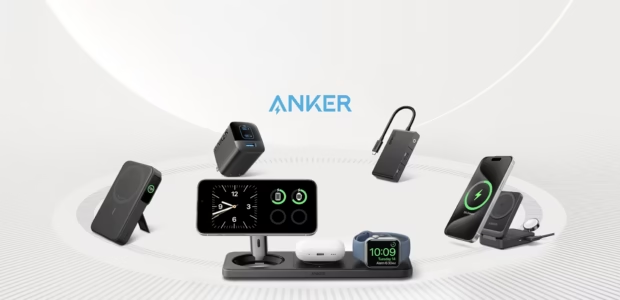
This Anker review tries to answer the two questions people search most: Is Anker a good brand? and Are Anker products worth it? Instead of describing every category in general terms, it looks at six specific products, covers their listed prices, features and known limitations, and then looks at warranty, customer support and who each product suits.
What Is Anker?
Anker is a consumer electronics company best known for charging products the official Anker website lists its current range. It was founded in 2011 by Steven Yang, a former Google engineer, and began by selling replacement laptop batteries and basic accessories online. It now sells in many countries through its own stores, Amazon and retail partners.
The wider Anker family also includes Soundcore (audio), Eufy (smart home), Nebula (projectors) and Anker SOLIX (portable power stations and solar). This review stays with the charging and connectivity range, which is where most buyers meet the brand.
What Type of Brand Is Anker?
Anker sits in the mid-range to premium part of the accessories market. It usually costs more than anonymous generic products and less than luxury brands. Its pitch is faster charging, smaller size and built-in safety protection at a price everyday buyers can consider.
What Is Anker Known For?
- Power banks, from pocket-sized units to laptop-capable models
- Compact GaN (gallium nitride) wall chargers
- USB-C and Lightning cables
- Wireless and magnetic (Qi2 and MagSafe-style) chargers
- USB-C hubs and docking stations
- Portable power stations for camping and backup power
How This Review Was Done
This is a research-based review. It draws on manufacturer listings and specification sheets, published third-party reviews, deal and retailer pages, and customer feedback posted on retailer sites. It is not a lab test, and it does not claim long-term hands-on testing of every product.
Prices change quickly and differ by country, so every price below is labelled with where it was seen. Treat them as reference points, not today’s checkout price.
Anker Price Check: Six Products Reviewed
| Product | Listed price | Lower price seen | Where seen |
|---|---|---|---|
| Anker Nano Power Bank (10,000mAh, 30W, built-in cable) | $49.99 | Not found | US reseller listing |
| Anker 735 Charger (65W, 3 ports) | $59.99 | $41.99 (GaNPrime version) | Deal post, undated |
| Anker 765 USB-C Cable (140W Nylon) | A$49.95 | $34.99 (6ft) | Anker Australia store; US deal listing |
| Anker MagGo 3-in-1 Stand | $99.99 to $110.99 | $59.99 to $71.23 | TechRadar; Anker US store |
| Anker 553 USB-C Hub (8-in-1) | About $70 | $50 | PCWorld deal post |
| Anker Prime Power Bank (26K, 300W) | $229.99 | $169.99 | Android Authority, Nov 2025 |
Anker price points differ between countries because of taxes, import costs and local sellers. If you want to see what is live right now, you can Grab Anker latest offers and promo codes on our Coupon Signal site.
Product 1: Anker Nano Power Bank (10,000mAh, 30W)
Best known for: being a pocket-friendly Anker power bank with a built-in USB-C cable.
What it offers: A 10,000mAh battery, 30W output with PowerIQ 3.0, two output connectors (the built-in USB-C cable and a USB port) and a weight of about 215g.
Price: $49.99 list price on a US reseller catalogue. For comparison, a UK listing shows £39.99. No discount was found in the sources used here.
Does the price feel justified? The built-in cable is the main convenience, since it removes one more item to carry. At $49.99 you are paying for that design and the brand’s protection features. A plain 10,000mAh power bank without a built-in cable can be found for less, so this one makes most sense if you value the integrated cable and compact shape.
Watch out for: 30W is enough for phones and small tablets, but it is not meant for laptops.
Product 2: Anker 735 Charger (65W, 3 Ports)
Anker chargers are where the brand’s compact GaN approach shows most clearly. The 735 has two USB-C ports and one USB-A port, and a single device can draw up to 65W. That covers most phones, tablets and many thin laptops.
Price: A deal post lists the GaNPrime version at $59.99 typically, with a sale price of $41.99. A separate Slickdeals post from October 2025 shows the Nano II 65W version at $25.99 on a Prime deal, against a normal price of about $40.
What stands out:
- Small body for the power it delivers
- Foldable plug, which helps with packing
- Intelligent power split on the GaNPrime version (the Nano II version uses fixed allocation, according to the deal post)
Mixed feedback: One buyer on a Slickdeals thread praised it as a travel charger for a laptop and phone. A retail reviewer in New Zealand reported that the GaNPrime 65W unit kept cutting out with a 12V 3A mini PC. This is one user’s report, but it is a reminder to check your device’s actual power needs.
Watch out for: “735” covers more than one version, so check the model number (A2667 or A2668) before comparing prices. This is a good example of why Anker’s naming can confuse buyers.
Product 3: Anker 765 USB-C Cable (140W Nylon)
A cable is easy to overlook, but it decides how fast your charger can actually work. The Anker 765 supports USB Power Delivery 3.1 up to 140W and is rated for 35,000 bends, according to Anker’s own listing.
Price: A$49.95 on the Anker Australia store. US deal listings show $34.99 for the 6ft version.
Does the price feel justified? For a phone-only user, a 140W cable is more than needed, and the Australian listing shows cheaper Anker cables, such as a 100W 543 cable at A$19.99. The 765 makes sense if you charge a laptop or want one cable that can handle high-wattage chargers.
Watch out for: The bend rating is a manufacturer figure, not an independent durability test.
Product 4: Anker MagGo Wireless Charging Station (3-in-1 Stand)
This stand charges an iPhone, an Apple Watch and AirPods together. It uses Qi2 with 15W magnetic charging for compatible iPhones.
Price: TechRadar lists $99.99 / $89.99 / AU$199.95 as the launch list price, while Anker’s US store lists the stand at $110.99. TechRadar has also reported discounts to $59.99 (white) and $71.23 (black) during Amazon sale periods.
What reviewers say: TechRadar gave the stand 4.5 stars, pointing to charging speed and a sturdy build. Wireless charging is still slower and less efficient than a cable, so it suits overnight and desk use more than a quick top-up.
Does the price feel justified? At list price it is a premium for convenience. At the sale prices mentioned above, the value case is stronger, particularly for people who already use an iPhone, Apple Watch and AirPods together.
Watch out for: It is designed around Apple devices, so Android users should check Qi2 support before buying.
Product 5: Anker 553 USB-C Hub (8-in-1)
For thin laptops with limited ports, a hub can be a daily tool. The 553 offers a USB-C port, two USB-A data ports, two HDMI ports, Ethernet and a microSD/SD card reader.
Price: PCWorld described the hub as usually $70 and reported it at $50 during a deal.
Performance notes:
- One display can run at 4K@60Hz, while two displays run at 4K@30Hz
- Pass-through charging reaches up to 85W, but a 100W charger and a 100W-capable cable are needed
- Anker states that a fully loaded hub may reach a surface temperature of around 131°F
- Anker’s listing says it cannot support 4K@60Hz on some laptops without Display Stream Compression
Customer feedback: A buyer on the Anker Canada store called it good value but was unhappy with the short attached cable, which wore over time.
Warranty: The store listing shows an 18-month warranty for this hub.
Product 6: Anker Prime Power Bank (26K, 300W)
This is Anker’s premium power bank. It has a 26,250mAh (99.75Wh) battery, 300W total output across two USB-C ports and one USB-A port, and up to 250W combined input. Anker lists a 24-month warranty.
Price: $229.99 list price. Chrome Unboxed reported a launch price of $184, and Android Authority reported a record low of $169.99 in November 2025.
What reviewers say: A Yahoo Tech review summed it up as buying speed rather than capacity. The reviewer felt it is a good buy if you need the fastest portable power bank and budget is not a concern.
Does the price feel justified? Only if you need its extra features, such as charging two laptops at once or very fast recharging. For phone and earbud users, the extra cost does not add much in daily use.
Watch out for: The 99.75Wh battery is just under the common 100Wh airline limit for carry-on bags, but check your airline’s own rules.
Quality and Safety: Are Anker Chargers Safe?
Across the listings reviewed here, Anker describes consistent protection features: temperature monitoring (the Prime charger lists ActiveShield 2.0), overcurrent protection and certified fast-charging standards such as USB Power Delivery. Anker’s listings for the hub and the 765 cable also state specific limits, such as heat and bend ratings, which is useful for buyers.
That said, these are brand claims. Safety also depends on using the right cable, avoiding damaged units and buying genuine products. Because Anker products are sold by many third-party sellers, buying from the official store or an authorised retailer is the safer route.
Performance and Value for Money
Performance follows the spec sheet in the cases above: a 65W charger charges a thin laptop, a 30W power bank suits phones, and a 140W cable only matters if the charger and device can use it. Where performance drops, it is usually because of a mismatch, such as a weak cable, a laptop that needs more watts, or a laptop that cannot output 4K@60Hz through a hub.
On value, the evidence points to a pattern. Anker’s mid-range items tend to be priced above generic options but often drop during sales, as the deal posts above show. Premium items such as the Prime power bank carry a clear price premium that only pays off if you use the extra output. Compare current listings before you pay.
Anker Warranty, Shipping, Returns and Support
Policies vary by country and seller, so treat these as general guidelines.
Warranty: The listings reviewed here show 24 months for the 765 cable, the Prime power bank and the 735 charger on its Amazon listing, and 18 months for the 553 hub. So the Anker warranty differs by product and region. It normally covers manufacturing defects, not physical damage or misuse.
Shipping and returns: Anker’s own stores list services such as free shipping above a minimum order and a 30-day money-back guarantee in some regions. Marketplace orders follow the seller’s policy.
Customer support: Anker offers support through email and online forms, and some stores mention lifetime customer support. Individual experiences vary by region.
Replacements and accessories: Cables, wall adapters and travel plugs are easy to find because Anker is a large brand, which is an advantage over lesser-known names.
What Do Customers Say About Anker?
The feedback gathered for this review comes from retailer pages, deal-site discussions and Anker’s own store pages.
Common positives
- Compact size for the power delivered, mentioned for the 65W charger
- Charging speed and sturdy build, noted for the MagGo stand
- A wide set of ports for the price, noted for the 553 hub
Common complaints
- Short attached cable on the 553 hub
- Possible cut-outs with a specific mini PC on a 65W GaNPrime charger
- Premium products, like the Prime power bank, priced well above basic options
Product-specific differences: Complaints tend to be about one model’s limits rather than the whole brand, which is why individual product research matters.
Limits of customer reviews: Reviews on Anker’s own site may be filtered by the brand, deal sites can earn affiliate commission, and one buyer’s problem may not represent most units. Read recent reviews on more than one platform.
Pros and Cons of Anker Products
Pros
- Compact GaN charger designs
- A wide range of wattage options, from 30W to 300W
- Multiple charging formats: wired, wireless, hub and power bank
- Good accessory availability
- Frequent sale prices, as the deal posts above show
Cons
- Premium models can be expensive
- A large product range and similar model names make comparison difficult
- Features vary significantly between models and versions
- Some products need careful compatibility checks, such as hub display limits and laptop wattage
Who Is Anker Best For?
Students: A small charger, one good cable and a compact power bank cover most daily needs.
Frequent travellers: Compact chargers and power banks under airline limits help reduce weight.
Remote workers: A hub and a multi-port charger can tidy up a desk, as long as your laptop’s wattage and display support are checked first.
Phone users: A basic fast charger and a mid-size power bank are usually enough. Premium models are rarely needed.
Laptop users: High-wattage chargers, 100W or 140W cables and laptop-capable power banks matter here.
People with multiple devices: Multi-port chargers and 3-in-1 wireless stations reduce cable clutter.
Are Anker Products Worth It?
The answer depends on how you use them.
- Daily heavy use: If you charge several devices every day or travel often, a higher price can make sense because you use the speed, ports and protection often.
- Occasional or basic use: If you only need a simple phone charger or cable and your budget is tight, a cheaper certified option may be enough.
- Premium models: Products such as the Prime power bank are only useful if you need the extra output or fast recharge speeds.
Check your own devices’ wattage, compare the current price and decide whether the extra features match your needs.
Tips Before You Buy Anker Products
- Check wattage needs. Know what your phone, tablet or laptop actually needs.
- Match the cable to the charger. A fast charger with a weak cable will not perform at its best.
- Check the exact model number. Names like “735” can cover more than one version.
- Compare during sale seasons. Anker prices often drop during major shopping events, and you can check current Anker coupons and deals on Coupon Signal before you pay.
- Buy from official or authorised sellers. This lowers the chance of fake products and warranty problems.
- Keep your invoice. It makes warranty claims easier.
Frequently Asked Questions (FAQs)
Based on the products reviewed, Anker offers detailed specifications, protection features and warranties of 18 to 24 months. Some products have limitations or mixed buyer feedback, so the answer depends on the model.
It depends on your use. Heavy daily users may value the speed and features, while occasional users may be fine with cheaper certified options.
Anker is an established technology brand with a broad range of charging and power products. Whether a particular Anker product is a good choice depends on its specifications, price and your intended use.
In the sources used here, the Anker Nano Power Bank (10,000mAh, 30W) lists at $49.99 and the Prime Power Bank (26K, 300W) at $229.99, with discounts reported to $169.99. Prices vary by country.
Yes. The listings reviewed show 24 months on several products and 18 months on the 553 hub. Check the exact product page.
Anker sells 65W to 300W chargers and power banks, plus hubs. Check your laptop’s required wattage and, for hubs, display support.
Many power banks under 100Wh can go in carry-on bags, and the Prime 26K is listed at 99.75Wh. Read the FAA’s lithium battery guidance and check your airline’s current rules.
Buy from the official store or authorised retailers, compare the model number with the official listing, and be careful with prices that look unusually low.
Final Verdict: Anker Review 2026
Anker is a large charging brand with a wide range, and this review does not pick a single best choice. What the research shows is a set of strengths and trade-offs.
Strengths: compact chargers, a range of wattage levels, clear warranties, and regular discounts.
Limitations: premium models can be costly, similar names can confuse buyers, and some products have limits such as hub display support or a short cable.
Who it suits: frequent travellers, remote workers, laptop users and people with several devices to charge each day.
When cheaper may be enough: occasional users, or anyone who only needs a basic phone charger and cable.
Check wattage, compare current prices and buy from a trusted seller. The right Anker product depends on what you need to charge.